..is out. The quest for clarity in the structure of the package, continues. Fine-tuning details in daily basis, and using dawo dev-notes to collect ideas and to track development of work. Stopping in #big areas, and presenting there only screen-full of random demo; that is our work-safe plan. Develop highly intelligent process-system, that is duty for other packages, not for dawo. Dawo is frames around ideas. Motto: do not take too big duties to yourself. Do not get lost in too big system; plan safe heavens there.
3 days before publish went with little changes and I plan to keep 3 days off after publish, to free mind and get distance to pack. Reading meanwhile actively all kind of programming stuff. I have enough ideas to dawo for next 5 GitHub update sessions and all they seem interesting and meaningful. Dawo is on the track.
Reading daily dartlang new stuff and talks is very interesting and educating. When you done it for years, it is getting new shapes: goals and phases in learning are more clear, and my vision inside language is changing. More clarity, more speed in reading. And now waiting Dart 2.0 ..
Dawo still includes much mess, forgive that, but we really are in early stage. Reading code might be heavy, but each new commit will make it more clear.
It seems to have taken for me years to reach this peaceful state of mind;
1. Be patient, plan "dead-ends" where you can throw nice demo and leave actual production (of wanted action) to other packages that are more suited and more advanced.
2. Trust yourself, and be happy of daily learning.
About 10 improvements are on the table for next, 0.0.5 version. What is subject of days work, is most often question of intuition, and is resolved in minutes, when I study files. Removing tools to new tl-class will however be the first one. But first I'll take three days off.
.
Monday, October 16, 2017

Tuesday, October 10, 2017
Nearing 0.0.4 version of dawo; tracking improvements.
| N:r | DONE | Value | Effort | AREA | Vers | ||
| #28 | D: 0 | V: 7 | E: 2 | pub | 0.0.4 | 'A. Publish version 0.0.4 to Pub 16.10.2017.' | |
| #1 | D: 0 | V: 4 | E: 6 | Lang | 0.0.4 | ' * Fill #Word data to buff. 20-30 items of app roll.’ | |
| #13 | D: 0 | V: 4 | E: 2 | duration.' | 0.0.4 | ' * Stamp time / Event-type’ | |
| #6 | D: 0 | V: 3 | E: 3 | Flow | 0.0.4 | ' * Get flow-output’ | |
| #2 | D: 0 | V: 3 | E: 3 | Lang | 0.0.4 | * Seek StringBuffer | |
| #22 | D: 0 | V: 3 | E: 5 | dev | 0.0.4 | ' * Present this map in sort-value order.' | |
| #19 | D: 9 | V: 6 | E: 5 | Chore | 0.0.4 | 'DONE * Chore report boxed. Common Op Boxedl’ | |
| #3 | D: 9 | V: 3 | E: 3 | Style | 0.0.4 | 'DON * Clean rest 7 of files for TODO and Notes.' | |
| #4 | D: 5 | V: 3 | E: 3 | Show | 0.0.4 | 'DONE Four box sided in devBox outPut.' | |
| #5 | D: 9 | V: 3 | E: 3 | Flow | 0.0.4 | 'DONE Empty all screen outPu tfor to get control on it-' | |
| #7 | D: 8 | V: 3 | E: 3 | boxed 2x2.' | 0.0.4 | 'DON Mission report’ | |
| #9 | D: 5 | V: 3 | E: 3 | dev | 0.0.4 | 'DO Dev-Notes’ | |
| #11 | D: 0 | V: 3 | E: 3 | Lang | 0.0.5 | '0.0.5 Word/ Lang. Create Lang class and methods.' | |
| #14 | D: 0 | V: 3 | E: 3 | indexedDB | 0.0.5 | '0.0.5 JSON | |
| #20 | D: 0 | V: 3 | E: 3 | pB | 0.0.5 | '0.0.5 Give pB -print variables in test-fileparameters.' | |
| #21 | D: 0 | V: 3 | E: 3 | dev | 0.0.5 | '0.0.5 Create #Issues list for dev.' | |
| #23 | D: 0 | V: 3 | E: 3 | pub | 0.0.5 | '0.0.5 6.11.2017 Version 0.0.5 Publish to Pub.' | |
| #12 | D: 0 | V: 3 | E: 3 | queue | 0.0.6 | '0.0.6 Use set enum, queue typedef aso. | |
| #15 | D: 0 | V: 3 | E: 3 | Stream | 0.0.6 | '0.0.6 Async | |
| #17 | D: 1 | V: 3 | E: 3 | Placard | 0.0.6 | 'D 0.0.6 Opera - placard. To carry data inside operations.' | |
| #24 | Mission | 0.0.6 | Mission: Switch-menu inside class for actions. | ||||
| #25 | Chore | 0.0.6 | Chore: Switch-menu inside class for actions. | ||||
| #18 | D: 0 | V: 3 | E: 3 | pB | 0.0.7 | '0.0.7 Change all pB (print) val to int 0 2 4 6 | |
| #27 | Show | 0.0.7 | '? ? - Resolve row-count / height.' | ||||
| #8 | D: 0 | V: 3 | E: 3 | Show | 0.0.8 | * Fine-Print-Map.' | |
| #10 | D: 0 | V: 3 | E: 3 | add field | ??? | '? ? Classes: field outBuf. Use in flow.' | |
| #16 | D: 0 | V: 3 | E: 3 | Render | ’8.8.8 | ' ? ? Render, make all them presentations. | |
| #26 | Unknown | ’8.8.8 | // TODO This kind of data might better be List<List<String>> |
Saturday, September 9, 2017
Tracking changes to versions 0.0.2 and 0.0.3 in Dart dawo package.
Development of dawo package 2017 further from 0.0.1 version
_____________________________________________________________________________
Way to version 0.0.2, possible fixes: Will be bublished to Pub: 10.9.-15.9.2017
1. DONE: Little roll / render example
2. DONE Readme file, README.md, modified
3. DONE Class constructors to every class
4. __e_ Import / export usage unclear. Get all files in one command.
- is analyzer acting weird? do not show variables (fast enough)
5. DONE Make Stream-play (sync) / explore file. ( BOORING! ) no, it was interesting :)
in code_snippets: learn_stream_sync
6. DONE Base structure class that important classes extend
- includes: - INIT-BUILD-ROLL-SHOW-DONE cycle
7. DONE StringBuffers to every important class and file for output.
- this also adds visibility for variable-name
8. _h__ Start: Connector-class; Connect App-Mission-Chore classes functionality in mill-process
- in this phase this is gonna be very elementary, schematic
- At the end this is fine-graded and long development plan. ( DIFFICULT :( )
9. DONE created DawoDewTest class in dawo_dew
10. DONE Add generic lists for every meaningful member
* like: List<CommonChore> choreL = []
* add usage later
_____________________________________________________________________________
Version NEXT: 0.0.3 aso. Plan.
3.1 ____ Active "Rumba" flow / -example
- app / mission / chore all working together
3.2 ____ Fill generic lists with members
Use generic lists inside classes for to control their "sub-ordinates"
dawoApp has: missionL<Mission>
mission has choreL<Chore>
Roll methods for them
3.3 ____ roll counters to app, mission, chore, mill
3.4 ____ render ( = test, presentation and quick-note function) to every file
3,5 ____ dev class. dev tester person
-every file imports dev, and can add dev-notes
3.6 ____ Team notes (List and maps) maybe: in clay_in folder = incoming data
* not yet clear idea, how this must be done
3.7 ____ incoming data in clay-folder
* dev data
* political-data (test-case)
3.8 ____ outGoing data methods in clayOut-folder
3.9 ____ sketch base_lib functionality
3.10 ____ separate learnLib with 3 files.
_________________________________________________________________________
Version NEXT: 0.0.4 aso
Working rumba is mark for 0.1.0 version
_________________________________________________________________________
_____________________________________________________________________________
Way to version 0.0.2, possible fixes: Will be bublished to Pub: 10.9.-15.9.2017
1. DONE: Little roll / render example
2. DONE Readme file, README.md, modified
3. DONE Class constructors to every class
4. __e_ Import / export usage unclear. Get all files in one command.
- is analyzer acting weird? do not show variables (fast enough)
5. DONE Make Stream-play (sync) / explore file. ( BOORING! ) no, it was interesting :)
in code_snippets: learn_stream_sync
6. DONE Base structure class that important classes extend
- includes: - INIT-BUILD-ROLL-SHOW-DONE cycle
7. DONE StringBuffers to every important class and file for output.
- this also adds visibility for variable-name
8. _h__ Start: Connector-class; Connect App-Mission-Chore classes functionality in mill-process
- in this phase this is gonna be very elementary, schematic
- At the end this is fine-graded and long development plan. ( DIFFICULT :( )
9. DONE created DawoDewTest class in dawo_dew
10. DONE Add generic lists for every meaningful member
* like: List<CommonChore> choreL = []
* add usage later
_____________________________________________________________________________
Version NEXT: 0.0.3 aso. Plan.
3.1 ____ Active "Rumba" flow / -example
- app / mission / chore all working together
3.2 ____ Fill generic lists with members
Use generic lists inside classes for to control their "sub-ordinates"
dawoApp has: missionL<Mission>
mission has choreL<Chore>
Roll methods for them
3.3 ____ roll counters to app, mission, chore, mill
3.4 ____ render ( = test, presentation and quick-note function) to every file
3,5 ____ dev class. dev tester person
-every file imports dev, and can add dev-notes
3.6 ____ Team notes (List and maps) maybe: in clay_in folder = incoming data
* not yet clear idea, how this must be done
3.7 ____ incoming data in clay-folder
* dev data
* political-data (test-case)
3.8 ____ outGoing data methods in clayOut-folder
3.9 ____ sketch base_lib functionality
3.10 ____ separate learnLib with 3 files.
_________________________________________________________________________
Version NEXT: 0.0.4 aso
Working rumba is mark for 0.1.0 version
_________________________________________________________________________
Wednesday, September 6, 2017
Publishing package dawo first real version in pub dartlang org
To see own package in pub is glorious, crossdart ( hyper-linked source code ) is deeply elegant to display source code, api docs is behind the link and link to github code, it is all there.Very elegant system, and now it is easy to start using dawo, and further it's development. Dry-publish was good to practice publishing. A very exciting event all over the place!
Code is all written about 2-3 years ago, so it is really elementary "beginners code".
And Dart's package system is deeply elegant and effective.
Picture of publishing event in windows cl window:

One file is missing, I think hist.txt was left in my dawo_old folder. Shall add it here.
Publish event was very fast and I can see my package and all links there in minutes.
Crossdart took a little longer. Bot tracking additions to pub.
Development line seems now quite clear.
Monday, September 4, 2017
Beginner Dart programmers kickoff to develop a glorious pub package; dawo
dawo package in github renewed; deleted and pushed again, to get folders aso. right.
Code: https://github.com/heiklap/dawo Here are first issues:
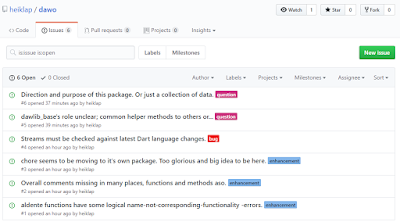
Mostly very elementary, simple data, little messy. Purpose is to document beginners steps, when developing a package. Next: choose where to head, what to take in and what to leave out.
An interesting and challenging journey is ahead.
Code: https://github.com/heiklap/dawo Here are first issues:

An interesting and challenging journey is ahead.
Saturday, August 19, 2017
Small note / short-hand descriptions of Dart Core Api
Dartlang Core-Api
CONSTANTSdeprecated deprecated = const Deprecated("next release")
override marks an instance member as overriding a superclass member with the
same name.
proxy marks a class as implementing members dynamically through
noSuchMethod
TYPEDEFS
Comparator The signature of a generic comparison function.
FUNCTIONS
identical Check whether two references are to the same object.
identityHashCode External : src: Returns the identity hash code of object.
print Prints a string representation of the object to the console.
Note: 4 external source's in object.
This table is created in GoogleDocs. Funny to see how nicely Docs/blogger
treats over-long rows of text.
.
Tuesday, December 8, 2015
Thin exnsions to my Dipp Dart app; and: creating common methods.
Certain phase in building my Dipp app: now I think to be ready for to build my first big app. Actually I need this for my learning; otherwise I might get stucked, and this brings some discipline here.
What? I'm building very thin, elementary and quick expansions (1-24) to Dipp. This "tree" is meant to be thin, for to avoid burden, which might come, when is time to make big fundamental changes. I hope to avoid later big changes, if I create in early phase some common-use methods and classes.
How am I here? Hard work, many erros, stupid slowness... and unwillingness to read howTo:s. Project Dipp seems right way to test-learn, and maybe -leave- it at any minute, if it feels so. Route is more important than goal.
How long will it be fun? Small steps policy... yep.. it means fun forever.
How is this work done? Very patiently and slowly, one step at a time. One happy hour a day.. at least. None of those 1-24 phases should take more than an hour to complete, by an exprerienced Dart programmer (not me).
How thin are they? Hermes might be just to check, that words in streams belong to 170-words lists. Server and-client parts: ready code examples with one default answer. Some might be just: -Not Ready Yet. HTTP requests are simple.. aso.
/// dipp development flow planList dppDevPlanL = [
  '1 Rondo everywhere and loopRun, runAll show sleep',
  '2 Main and Side Data',

  '3 CL Boxes',
  '4 Web  Dom / Rondo',

  '5 UP-comXX  commands',
  '6     ',

  '7 Stream Connection',
  '8 StringBuffer connection  Buffalo',

  '9 Labor    data',
  '10 Plugins and their data',
  '11 Flags, ables',
  '12 Zyld, structures',

  '13 Hermes',
  '14 Hermit  ',

  '15 Webster DB Mongo',
  '16 Webster  List, text  ',

  '17 Work, tools, effort',
  '18 Ideas, learn, funny',

  '19     ',
  '20 HTTP  data',

  '21 Asker  server',
  '22 Asker  client',

  '23 async  version',
  '24     '];
About Dipp app: Dipp is for collecting and presenting information in various ways.
About 50 classes are grouped under control of 4 main classes: DippApp,wich keeps plugins and extras. Venue,is like theatre where main flow happends, aso. Parade,which presents Frames. Worker package is used in Hermit class.
Dipp has 4 main parts / ideas:
1. Plugins, that give extra functionality and data to other apps
2. Human / labor like entities, that have their own nature, like Newton.
3. Main data-flow and UNLRS-class which gives main functionality to central Dipp classes.
4. Extra-functionality under DipApp; Server-client-DB-connections-HTTP aso.
Basic class is UNLRS. Upper-Name-loop-run-show class, which gives much of needed ability to main classes, to run, handle and present their data and show statistic info.
1. Rondo is common run-method, which gets much automation from UNLRS-class.
5. up-comXX are 2-letter common upper-level variables. Editor can easy find them.
7.8. StreamConnection and StringBuffer connections from inside UNLRS class.
9.Labor is about human - worker like objects that have their own nature and interests.
10. Plugins. In this state is plan to make one of 10:s ready.
11. Flags control some abilities that objects has. I love bits "0100 1011 11", but they might be too difficult, compared to booleans.
12. Zyld is data cylinder. Just a plain idea for now.
13. Hermes is big plan, "Gods messenger" with it's own language handling messages between objects.
14. Hermit is isolates, threads.
15.16. Webster is about Databse,Mongo and simpler data
17. Work, tools effort are some extra folders and files.
18. Ideas - learn, funny... nmore folders with ideas.
20. HTTP data. Objects might have every their own data in the web for daily search.
21.22. Asker is server-client system for objects data. Plan: Copy-paste from Dartlang.
23. Quick async-version in just one tiny web file.
24. More ideas to come
And common methods, which are to be developed here. What might they be?
1. Complicated function for giving access to Streams from inside a class.
2. Same with StringBuffer. Remember; Dart do not have nested classes.
3. Presenting "List lof Data" in "List Of Screen Dom elements".
4. Handling bit-data and developing bit tables / booleans.
5. Common methods for seeking data from diff sources and storing it.
6. Some more sophisticated base-classes for special cases.
7. more...
8. ...And more...
And: also these must be very thin and schematic.
And some routines / basic elements for web programming.
Subscribe to:
Posts (Atom)